
Public Art

Image credit: Angie Quintanilla Coates, Life Is a Kaleidoscope, 2024, acrylic on wood relief. Courtesy of the Artist.
30th Anniversary Public Artworks
The Gallery at Evergreen Arts
Evergreen Arts Season Launch Saturday, September 19
On the Dot: Mini Artwork Tours
5:30 PM: Jordanna George: Full Moon
6:00 PM: Laara Cerman: Flora’s Song No. 1 in C Major
6:30 PM: Angie Quintanilla Coates: Life Is a Kaleidoscope
Celebrating Evergreen Arts’ 30th Anniversary, The Gallery at Evergreen Arts presents three public artworks by Tri-Cities artists that enliven our facade with the same creative spirit that unfolds within our centre.
All year round, The Gallery at Evergreen Arts presents a curated series of public artworks in our neighbourhood. These installations complement our gallery programming and offer a chance for visitors, parkgoers and transit users to engage freely with contemporary art in our community. To celebrate Evergreen Arts’ 30th anniversary, artworks by Tri-Cities artists appear on the building’s exterior. These public works enliven our building facade with the same creative spirit that unfolds within. Art by Port Coquitlam’s Laara Cerman, Port Moody’s Angie Quintanilla Coates and Coquitlam’s Jordanna George kick off our 2026/27 Season.

Image credit: Cherry Archer, Botanical Ice Tiles, 2021–, site-specific installation at Lafarge Lake-Douglas SkyTrain Station, 2026. Presented by The Gallery at Evergreen Arts and TransLink. Photo: Rachel Topham Photography.
Cherry Archer: Botanical Ice Tiles
Lafarge Lake–Douglas SkyTrain Station 2026 – 2028

Presented by The Gallery at Evergreen Arts and TransLink
Image credit: Angie Quintanilla Coates, Life Is a Kaleidoscope, 2024, acrylic on wood relief. Courtesy of the Artist.
Angie Quintanilla Coates: Life Is a Kaleidoscope
August 2026 – August 2028
Evergreen Arts Studio D
Angie Quintanilla Coates’s artworks share her spirit of persistent joyfulness that comes from her Mexican culture. Their colours and geometric forms celebrate a bold optimism and jubilant investigation of form. This mindset reflects the open curiosity, creativity and playful thinking of our Arts Education Department. Adapted from her painting Life Is a Kaleidoscope (2024), Coates’s design for our classroom windows mirrors the creativity of Evergreen Arts’ youngest artists. Coates is a Mexican visual artist based in Port Moody who creates geometric compositions with vibrant colours.
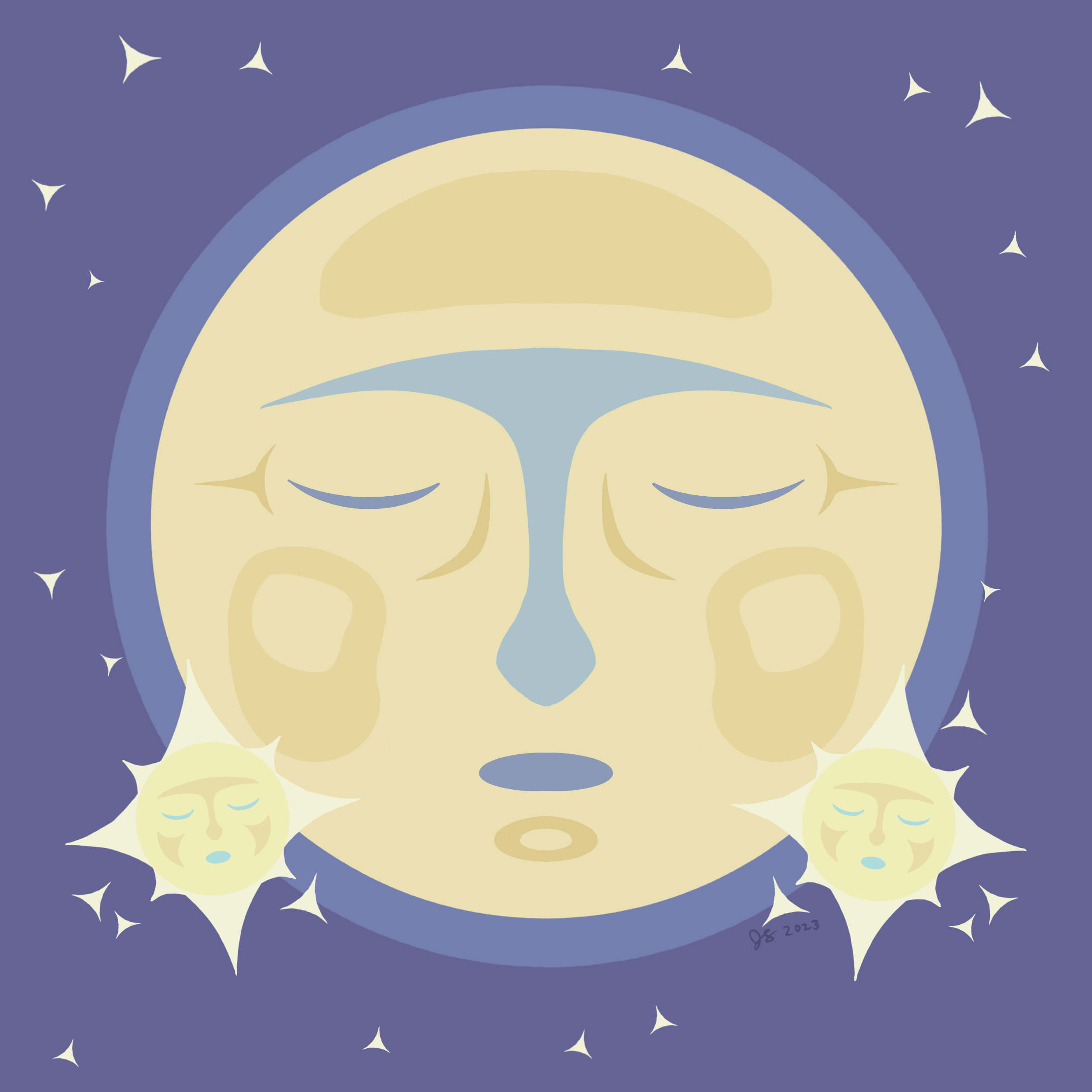
Image credit: Jordanna George, Moon 1, 2023, digital. Courtesy of the Artist.
Jordanna George: Full Moon
Evergreen Arts Portico
September 2026 – February 2027
To reconnect with their Salish roots, Jordanna George completed a “full moon art challenge,” started by artist Ocean Hyland on social media in 2023. George created one artwork for each full moon that year. Three of these moons, each in Coast Salish style, are exhibited as lightboxes at Evergreen Arts, celebrating Indigenous presence on this land since time immemorial. George is an artist of mixed T’Sou-ke and Ukrainian ancestry. Originally from Sooke, BC, they now live on the unceded territories of the xʷməθkʷəy̓əm (Musqueam), Sḵwx̱wú7mesh (Squamish), səlilwətaʔɬ (Tsleil-Waututh), and kʷikʷəƛ̓əm (Kwikwetlem) nations in Coquitlam. Through comics and illustration, their work explores themes of identity, belonging and hope, drawing influence from Indigeneity, queerness and science fiction.
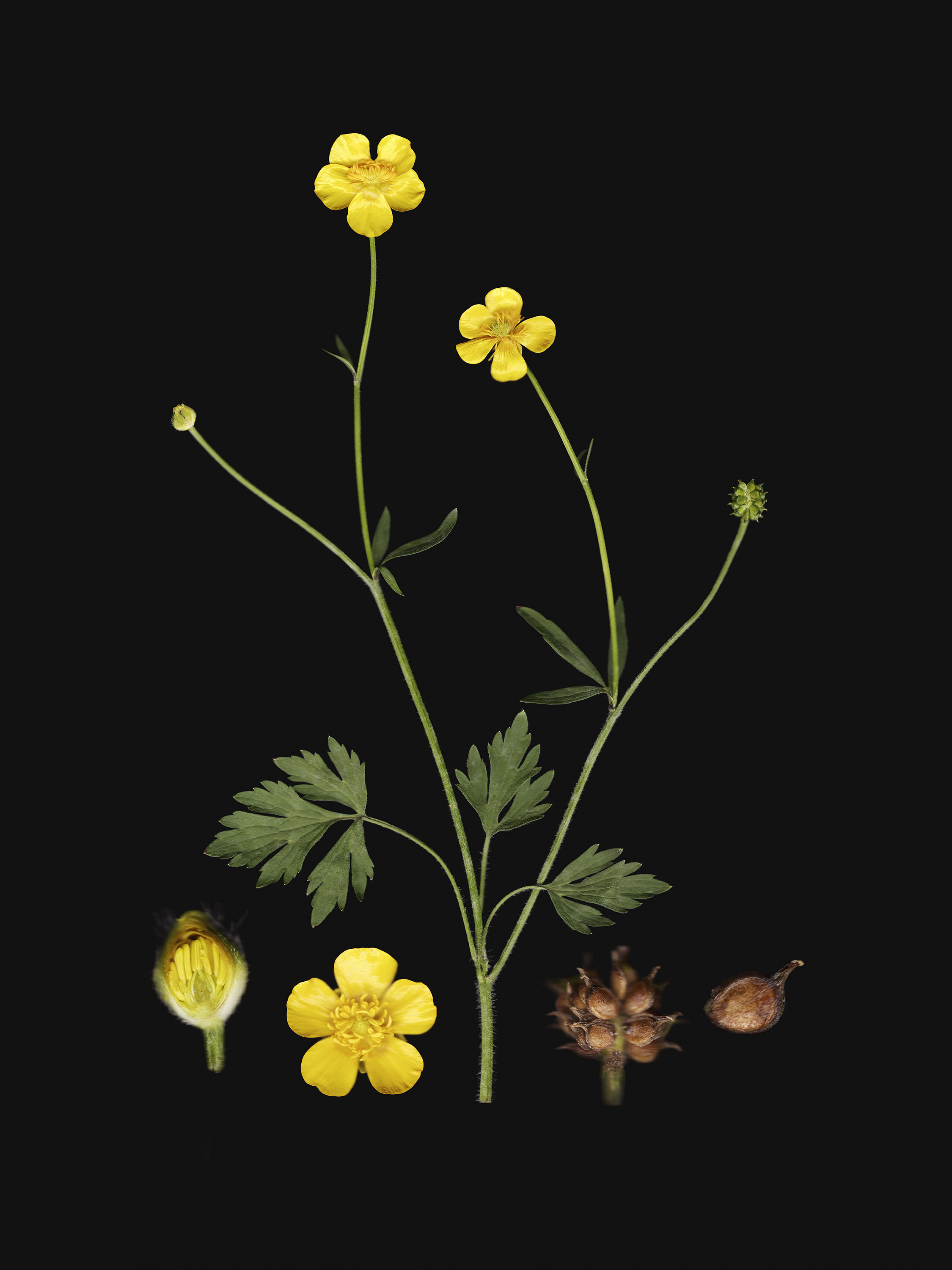
Image credit: Laara Cerman, Ranunculaceae. (Ranunculus repens) Creeping Buttercup, 2019, C-print. Courtesy of the Artist.
Laara Cerman: Flora’s Song No. 1 in C Major
September 2026 – February 2027
Evergreen Arts Lobby
Plants are seen, touched, smelled and tasted—but what if they could be heard? Flora’s Song No1. in C Major is composed using a sequence of DNA from two invasive plants, creeping buttercup (Ranunculus repens) and brown knapweed (Centaurea jacea). The song translates the nucleotides in DNA (A, T, C, G) to the notes in the chords E minor 7 (E, G, B, D) and C major 7 (C, E, G, B), which play simultaneously on a pipe glockenspiel within a handmade music box. Born and raised in Port Coquitlam, Cerman investigates the natural world through sculpture and image–making, informed by the ecology and botany of British Columbia’s coastal forests.
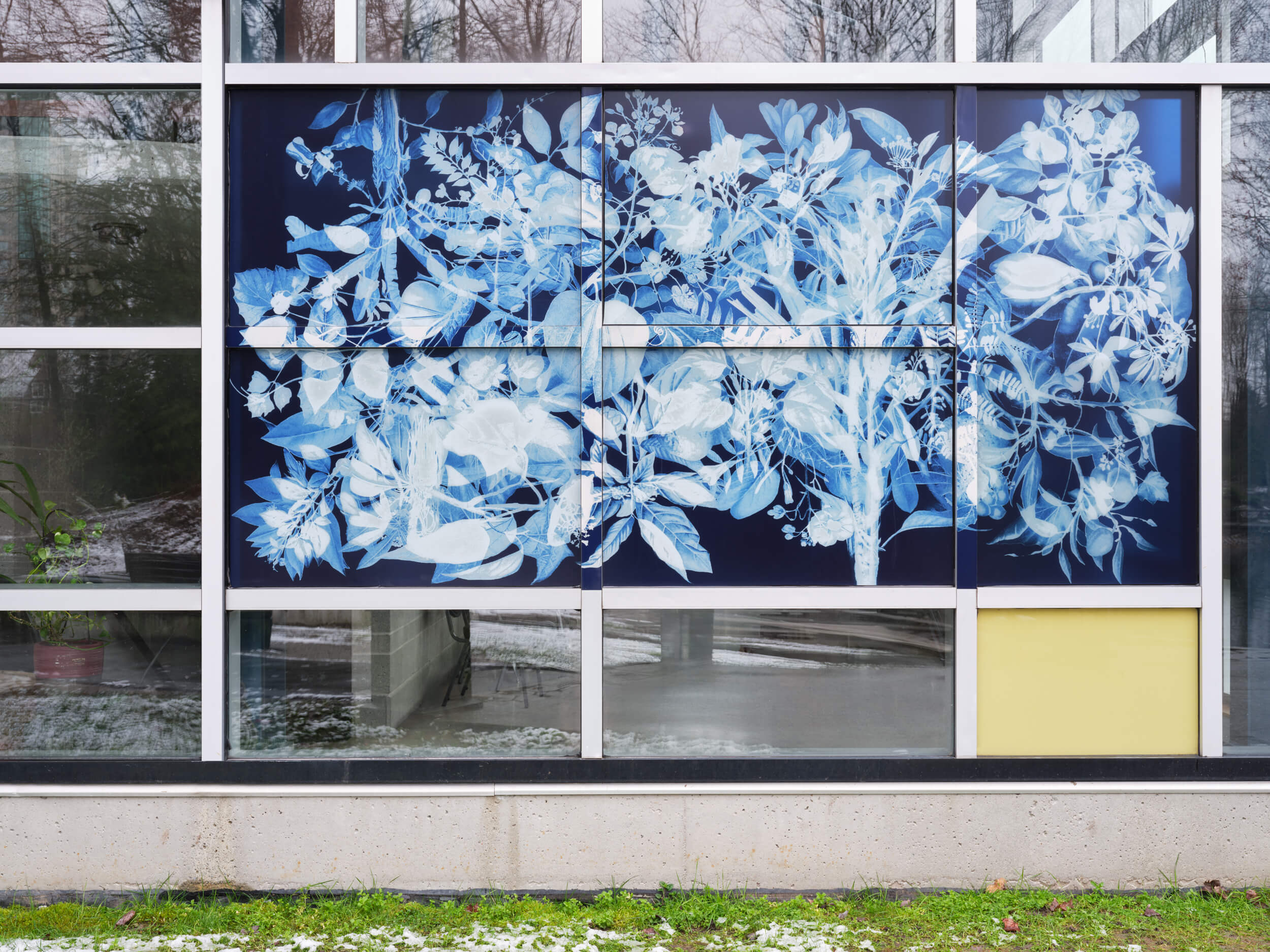
Image: Karen Zalamea, Herbarium (after Flora de Filipinas), 2024-2025, site-specific installation at , exhibition at The Gallery at Evergreen Arts, 2026. Photo: Rachel Topham Photography.
Karen Zalamea: Herbarium (after Flora de Filipinas)
The artist created digital negatives from scans of the botanical illustrations to make cyanotypes: a camera-less photo technique where an object or negative is placed onto a light-sensitized surface, then exposed to daylight to create an image. In this mural-like interpretation, the sunlight has a different role—it instead courses through the vinyl window coverings to create a translucent, stained-glass effect.
Like how Zalamea reconfigures existing botanical illustrations into cyanotypes in Herbarium, the translation of the original cyanotype artwork into the window installation showcases the life cycle of images—continuously replicated and consequently spread. With the artwork reformatted to fit Evergreen’s windows facing Lafarge Lake, the troubled stories that Herbarium tells here mirror the work’s localized context. It offers us a moment to reflect on how colonialist projects and ideals were implemented through the development of Lafarge Lake, which has forever altered local surroundings.
This public art project is part of the 2026 Capture Photography Festival’s Public Art Program.